

ICELAND - OFF THE PATH 8 days
This itinerary visits Reykjavik, the Snæfellsnes Peninsula, Strokkur Geysir, Gullfoss waterfall, the unique landscape of Landmannalaugar, Skogafoss, the Fimmvörðuháls hiking trail, Seljalandsfoss, the town of Vik, and its black beach.
Iceland is a Nordic island in the North Atlantic with 400,000 people, making it Europe's least crowded country. It has many volcanoes and active geology. The land inside is a plateau with sand, lava, mountains, cold tundra, and glaciers. The Gulf Stream keeps Iceland’s climate mild, even though it is near the Arctic Circle.

🇮🇸 Essential Tips:
To plan and explore the best of Iceland, do NOT make Reykjavik your home base.
Travel around the country. There is so much to see that it is impossible to reach it all from Reykjavik.
Car rental is your best option, with freedom to venture wherever.
Safety tip: 112 Iceland is the app for the Icelandic Emergency Services, a necessary download if visiting the remote areas.
Iceland does not officially use the Euro, but there are some businesses that accept it.
The only legal currency is the Icelandic Krona (ISK). ATMs are available throughout the country.
Download the AllTrails app on your smartphone. Essential for any trek in Iceland.
The weather in Iceland is unpredictable and can change quickly at any time.
No matter the season, visitors should always have wind and water-resistant outerwear plus extra thermal layers on hand before heading out on excursions. Bring windproof pants for most hikes.
On the website of the Icelandic Meteorological Office, and in Belging, you can find good information about weather forecasts.
Travel Guides: Fodor’s Iceland and Lonely Planet Iceland or DK Eyewitness Iceland.
🌋Safetravel.is: check for the latest updates on any volcanic activity and trail closures before heading out. <map>

Map of Reykjavik
DAY 1
Arrive at Reykjavik airport.
Proceed to the car rental pickup and transfer to your hotel.
In Reykjavik, you can relax or browse the shops and restaurants on tourist-packed Laugavegur Street.
Overnight: Reykjavik
Distance: Airport ---> Reykjavik, 40 minutes.
DAYS 2 and 3
Explore the Snæfellsnes Peninsula in western Iceland.
The region is known for its dramatic landscapes. [Map]
Snæfellsjökull National Park is dominated by Snæfellsjökull Volcano, which is topped by a glacier.
Kirkjufell Mountain - one of the most photographed spots on the planet!
Just west of Grundarfjörður. Photographers gather by several small waterfalls beside the main road. A short 5‑minute walk.
<Where to take the photo>Impressive, gorgeous, beautiful. Enough said.
Raudfeldsgjaa Gorge - a deep, high, and narrow ravine in the cliffs.
Budir Black Church -the small black church sits amid Iceland’s rugged landscape, its dark color striking against the distant, cloudy mountains.
Discover Arnarstapi and Hellnar Fishing Villages:
These two (2) small adjacent villages are in the southern part of the lava fields in the Snæfellsnes peninsula.
The scenic coast consists of a 2.5 km hiking trail that connects the two (2) villages.
At the start of the trail in Hellnar is Fjöruhúsið café. An excellent lunch spot!
Londrangar Basalt cliffs - two large pillars towering along the shoreline.
Djupalon - a scenic black beach worth a stop.
Bjargarsteinn Mathus Restaurant in Grundarfjörður - excellent, reservations recommended.
Overnight: Grundarfjörður
Distance: Reykjavik ---> Snaefellsnes Peninsula 2.5 hrs.
DAY 4
Next stop is thundering Gullfoss, the most famous in Iceland. Close by, witness the eruptions at the Geyser area.
If time permits, continue to a hidden gem waterfall, Bruarfoss Falls.
The water is a vivid blue, creating a stunning scene and perfect for photos.It is an easy 7 km flat trail. Learn more: [trail details] [directions]
Overnight: Fludir area
Distance: Snaefellsnes Peninsula ---> Fludir, 3.5 hrs. / 250 km.
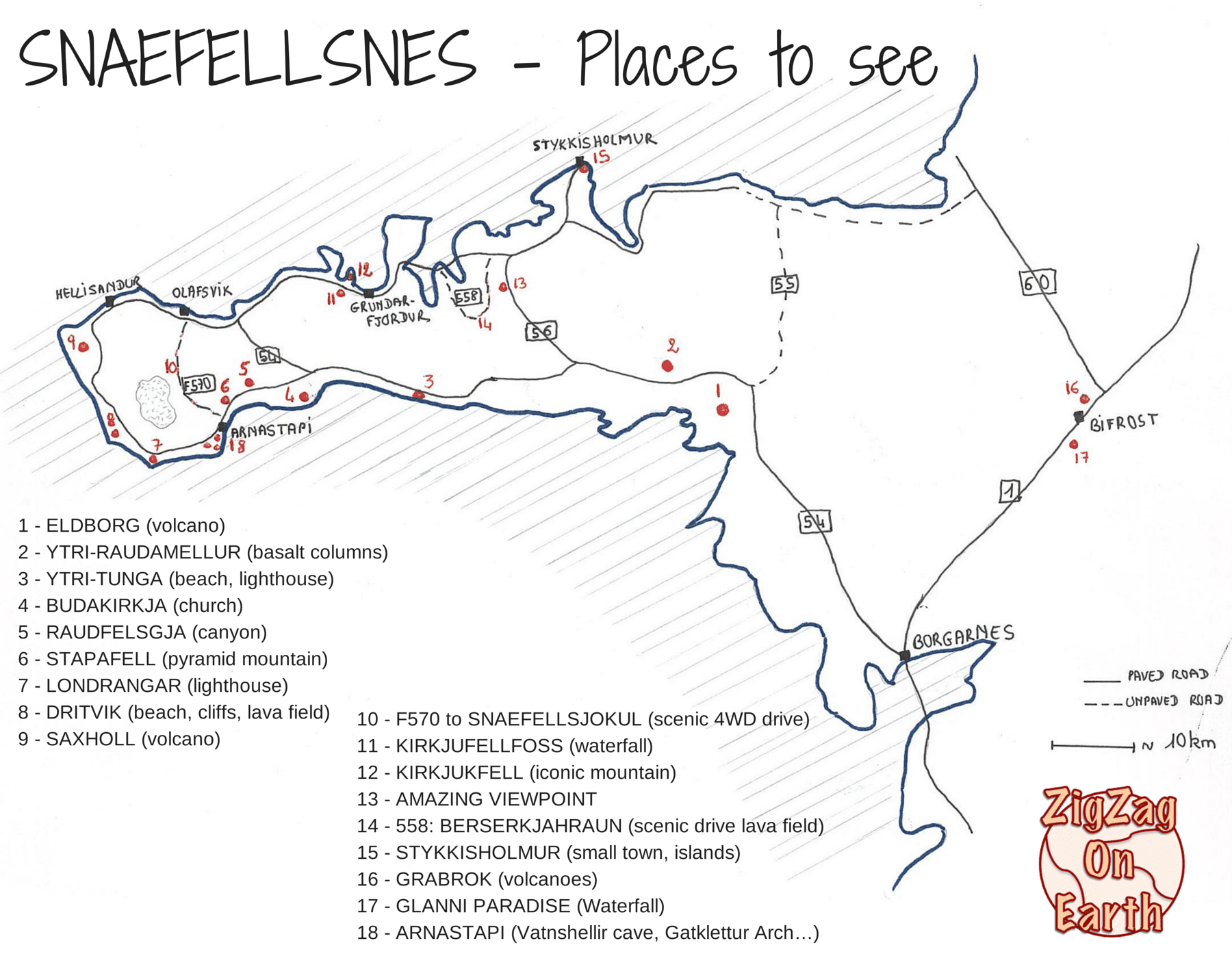
Snaefellsnes Points of Interest
Source: ZigZagonearth.com
![Fjöruhúsið is a cozy café located on a beautiful spot near the coast, offering home-made cooking, excellent fish soup, fresh bread, pastries, and waffles with jam and whipped cream. A popular 2.5 km coastal [ hiking trail ] starts at Fjöruhúsið](https://images.squarespace-cdn.com/content/v1/5af8a305c3c16a3922fc7826/1749148605931-T1VMO4CW3CIADYPOMPVA/fjor%2Bcafe.jpg)


Learn more - Landmannalaugar
DAY 5
A breathtaking adventure to Landmannalaugar.
[Location]
Landmannalaugar is a truly rare geological area. [Gallery]
The windswept rhyolite mountains show brilliant reds, pinks, greens, blues, and golds, creating a stunning landscape.
Be sure you do at least one hike in the region.
Three(3) popular trails are:
1. Brennisteinsalda Loop: This short loop trail leads to the summit of Brennisteinsalda, a colorful volcanic mountain.
The hike gives panoramic views of nearby lava fields and geothermal areas.2. Bláhnjúkur (Blue Peak) Trail: Bláhnjúkur is a distinct blue peak reached by a marked trail from the Landmannalaugar campsite. The hike is moderately hard and offers stunning views of the colorful mountains and the surrounding area.
The trail takes around 2-3 hours to complete the round trip.3. Ljótipollur Trail: Ljótipollur is a striking volcanic crater lake near Landmannalaugar. The trail is fairly easy and family-friendly, passing colorful mountains, lava fields, and mossy slopes. The round-trip hike takes about 2–3 hours.
The only accommodations available are the campsite and the huts.
💧 Bring plenty of snacks and water.
⚠️ Alert: make sure you’ve got enough petrol for your return journey.
If time permits, make a quick stop at SIGÖDUGLJÚFUR, one of ICELAND’S most BEAUTIFUL WATERFALLS. <photo>
<Getting there> You will be on F-roads, classified as mountain roads, an unpaved gravel track. (more about F-roads below)
⚠️ Part of the road is bumpy with small rocks, washboards, and potholes.Overnight: Fludir area
Distance: Fludir ---> Langmannalaugar, 2 hrs.
F-Roads generally open June 15 to Sept 15.
F-roads in Iceland are mountain roads, unpaved gravel tracks.
Prefixed with an F, such as F210, they have large potholes, many ruts, or boulders on their surface.
Under NO circumstances should you attempt driving the F-roads to Landmannalaugar in a compact rental car.
A 4 x 4 car is a must!
Even with a 4x4, travelers should be warned not to cross deep rivers without experience.
Check if the car rental allows driving on F‑Roads before you rent.
.
DAY 6
Highlights in the Skógarfoss region:
One of the most famous hiking trails in Iceland, the Fimmvörðuháls Trek is a legendary trail that passes between two giant glaciers, the Eyjafjallajökull glacier and the Mýrdalsjökull glacier.
The Fimmvörðuháls hiking trail takes you through almost every landscape Iceland has to offer.
Always be prepared for changing weather. Starting Point: Skogafoss Waterfall parking lot.
For a WONDERFUL DAY HIKE, especially if you like continuous and varied waterfalls (about 12), walk north from the Skogafoss waterfall along the Fimmvörðuháls trail for about 2 hours one way, then return back.
Alternative Option: The entire Fimmvörðuháls trail takes 14-16 hours to complete and covers approximately
25 km (15 mi). The trek takes two days, depending on your pace. An extra day and camping are required. [Map]
A tour operator (Extreme Iceland) is highly recommended.* * * * * * * * * * * * * * *
Continue to Vik, Iceland.
The village of Vík is the southernmost town in Iceland, located on Route 1, around 180 km southeast of Reykjavík.
Overnight: Vik
Distance: Skogafoss ---> Vik, 35 minutes.
-
Reynisfjara is without a doubt the most famous beach in all of Iceland, and you’ll see it featured on postcards and brochures throughout the country, as well as on pretty much any travel blog or video about Iceland.
What sets Reynisfjara apart from all the rest are its black volcanic sands, smooth pebbles, unique rock formations, overall moody atmosphere, and—more on this below—huge waves crashing on the shore.
From the beach, you have a view to the Reynisdrangar sea stacks. These bizarre-looking rock pillars are said to be petrified trolls that were caught outside at sunrise and frozen in time, but some strongly believe that they’re actually basalt columns that were once part of the extensive shoreline cliffs that remained standing while other parts were battered down by the ocean. Whichever story you choose to believe, they’re a sight to behold.
Also along Reynisfjara are the stunning Hálsanefshellir sea cave and the Gardar cliff, which is composed of dark basalt columns that some say resemble a pyramid or organ pipes. From the shore, you’ll also have spectacular views of the arched cliff of Dyrhólaey looming over the sea.
If all this sightseeing has left you hungry, a light meal or a coffee can be found at the Black Beach Restaurant near the beach. The nearby town of Vík also features a service station with a fast-food diner and a café.
Extreme caution is to be exercised at all times while visiting Reynisfjara. Stay far back from the water's edge and heed all signs and warnings. Though the beach is stunning, please be careful as rogue waves are common, and the current is very strong.
-
<Map>
DAY 7
Explore the Vik region.
Vik is a village known for black sand beaches, puffins, and glacier tours. It’s ideal for relaxing stays and outdoor adventures. [Learn more]
Dyrholaey - a naturally formed arch on the coast, making a nice photo-op.
Reynisfjara Black Beach - the most famous black beach in Iceland. [video]
Seljalandsfoss - between Selfoss and Vik. It is located along the intersection of Route 1 and Þórsmörk Road 249.
The falls are a popular Icelandic photography spot and have appeared on TV’s Amazing Race.
Why is the waterfall special? It’s the only waterfall that you can walk BEHIND.
Overnight: Reykjavik
Distance:
Vik ---> Seljalandsfoss. 50 minutes.
Seljalandsfoss ---> Reykjavik. 2 hrs.
DAY 8
End of your adventure. Return home.


-
1. When is daylight in Iceland ?
From mid-May to mid-August the sun only sets for only a few hours per day, and it is effectively light for the whole 24-hour period. This phenomenon is known as the "midnight sun" and it creates a sort of lingering twilight in the nighttime hours.
2. How should I drive in Iceland? Driving is the most popular way of getting around for visitors in Iceland, and the roads are generally safe for attentive drivers. Just like the USA, driving is on the right side of the road.
3. What kind of monetary unit does Iceland have?
The Icelandic monetary unit is the króna and is usually abbreviated as ISK or kr.4. What is the tipping policy in Iceland?
Service and VAT are invariably included in prices in Iceland and tipping is never required. However, if you are very pleased with the service, Icelanders are generally not offended if they are offered tips.5. What are Icelanders like?
Well educated, proficient in speaking English, sophisticated dressers, modern, reserved, friendly, creative, relaxed and generally helpful to tourists.6. What kind of electrical outlet is used in Iceland?
Icelandic electrical standards are the same as other Northern European countries (50Hz, 240 volts) so North American electrical devices will require converters and/or adapters.7. What is the travel visa policy in Iceland?
Citizens from USA and Canada do not require visas.8. When is the best time to see the Northern Lights ?
Best time is late September to late March.
9. Is Iceland safe ?
Iceland is one of the safest countries in the world. Crime is extremely low and medical care is excellent.
10. Can I Snowmobile? go Caving ?
Iceland is a excellent place for both activities in winter. We suggest Extreme Iceland tours.

Search for your hotel


Average cost:
(EXCLUDING AIRFARE)
$$$ USD for two (2) people
Budget: $3,100
Moderate: $3,800
Luxury: $4,700 +

🌤️ Climate

When is the best time to go to Iceland? Mid-June to mid-September.
On an annual basis, Reykjavik has 225 precipitation days.
The warmest months are June, July, and August.
The coldest months are November through February
October is the wettest month. May is the driest.
Approximately 20 hours of daylight during months of June and July
Aurora Borealis (Northern Lights) Visible under dark, clear conditions from October to mid- March.
Iceland Gallery
Video



Landmannalauger Gallery
Fimmvörðuháls Gallery


Source: www.inafarawayland.com, wikepedia. www.nat.is/fimmvorduhals-hike-skogar-to-thorsmork, zig-zag on earth.com, grunnkort/Loftmyndir.ehf
No copyright infringement is intended on this website by travelwildnow.com