

ALASKA 7 DAYS + Extensions
Alaska isn't just a destination—it’s a scale of pure wilderness. Over half of this massive territory is protected, untouched land. From towering granite peaks to coastlines teeming with life, this journey drops you directly into the most iconic landscapes of the Last Frontier.
🏔️The Majestic Interior. Begin your adventure in the vibrant streets of Anchorage before stepping back in time through the historic charm of Talkeetna. From there, journey deep into the crown jewel of the North: Denali National Park, where wandering moose and caribou roam beneath the shadow of North America's highest peak.
🐋 The Rugged Coast & Wild Peninsula. Cruise past the dramatic tidewater glaciers and deep, icy waters of Kenai Fjords. For the ultimate wild experience, venture to the volcanic landscapes of Katmai to witness giant brown bears fishing at salmon-run rapids.
🌲 The Inside Passage. Complete the dream in Juneau, Alaska's picturesque capital. Nestled deep in the panhandle, it's a world where pristine national forests meet waters teeming with whales, sea otters, and puffins.
<Scroll down to the bottom of the page for the Photo Gallery>

Essential Tips:
Guidebooks: Fodor’s Alaska and Lonely Planet-Alaska and Moon Alaska.
The Travel Alaska website provides valuable insights.
Download the All-trails app to your smartphone to find the best hiking trail.
🚗 Renting a car is best — Alaska is massive, and a car saves time and lets you see more.
Getting There:
Flight time to Alaska from various cities: New York~7 hrs. / Chicago-5.5 hrs. / Dallas-6.5 hrs. / Los Angeles-5 hrs.
🎒 Packing & Gear:
What type of clothing should you pack?
Wear casual, comfortable clothes you can layer. Even in summer, bring rain- and wind-resistant items.
Comfortable walking shoes or water‑repellent hiking boots are essential.For day cruises, pack a scarf, hat, and gloves — it can get cold on the boat.
Mosquitoes - bring high-DEET or Picaridin repellent. A face net helps in Denali.
Wildlife & Safety:
Buy Bear Spray - You cannot fly with bear spray. Plan to buy a canister at an outdoor shop in Anchorage as soon as you arrive.
The National Park Service says a bear attack is very rare — about 1 in 2 million.
Important facts about bears.
Be Bear Smart: Make noise while hiking (clap, talk loudly), never hike alone, and keep all food in airtight containers.
Mosquito and Black Flies:
Alaska's notorious insect population thrives because melting snow cannot drain through the frozen permafrost, creating ideal breeding bogs. Bug severity depends heavily on the time of year and location:
The Peak (Mid-June to July): The worst time for mosquitoes, driven by the spring hatch and long, warm days.
The Second Wave (Late July): Biting black flies ("white socks") and no-see-ums take over, especially near moving water, leaving intensely itchy bites.
👍 Best Times to Avoid Them: Aim for before May 20th (when temperatures are too chilly for activity) or
after August 15th (when nighttime frosts kill off the vast majority of insects).
✨ Must-See Experiences:
If your interest is the Northern Lights (Seasonal), the best time is from October to March.
The areas of Eklutna Tailrace, Girdwood, and the Knik River region are all popular spots close to Anchorage for viewing the shifting colors. [directions]

DAY 1
Arrive at Anchorage airport and transfer to your hotel.
Anchorage - Alaska’s largest city - is the gateway to its wilderness and mountains.
If your flight lands with time to spare, stroll along the Anchorage Tony Knowles Coastal Trail.
This paved trail runs 11 miles one way, offering activities like biking, walking, and even wildlife observation.
On the trail, you may spot majestic eagles and moose.The trail runs from downtown Anchorage to Kincaid Park, passing coastal marshes with lovely views of the city.
[Trail map] GPS coordinate: 61°13'04.2 N 149°54'29.8 W
Various Parking Tips and Trail Access:
Elderberry Park (1297 W. Fifth Ave.)
Margaret Eagan Sullivan Park (1824 W. 15th Ave.)
Lyn Ary Park (2009 Foraker Drive)
Earthquake Park (5101 Point Woronzof Road)
Point Woronzof Overlook (9700 Point Woronzof Road)
Kincaid Park (9401 Raspberry Road)
Overnight: Anchorage
DAY 2
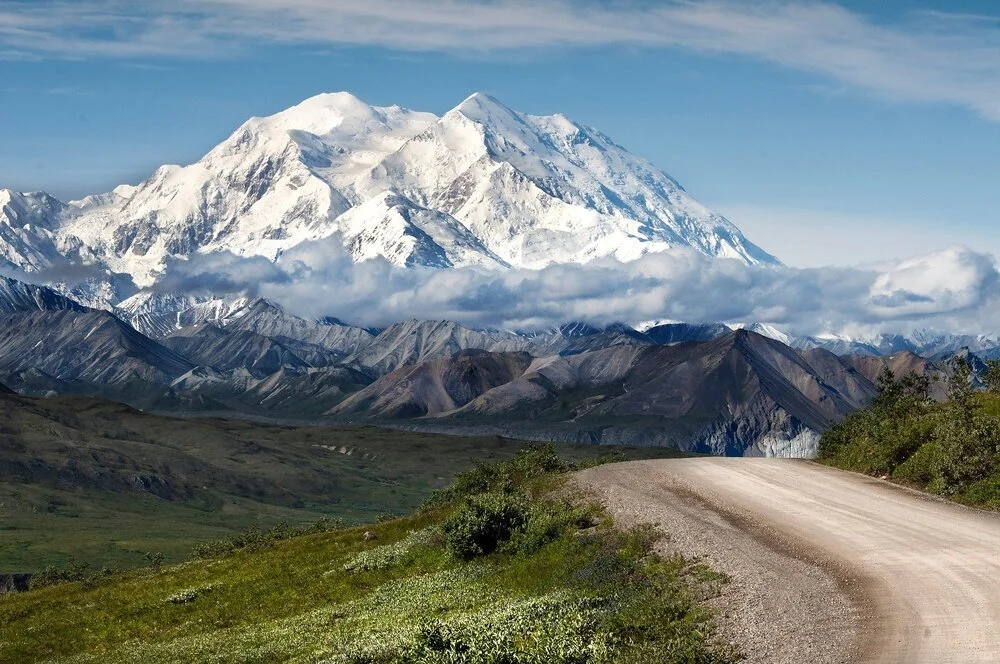
Travel from Anchorage to Denali National Park to see Denali (Mount McKinley), North America's highest peak at 20,310 ft.
The park is home to abundant wildlife, including grizzly bears, wolves, moose, caribou, and Dall sheep.
Talkeetna is a must-visit stop (located halfway between Anchorage and Denali) where you will find quaint shops and local breweries. The most popular activities are
Mt. McKinley flightseeing tours (only worth it on a clear day), historic riverboat tours, and jet boat rides on a glacier-fed river.After your stop in Talkeetna, continue north up the George Parks Highway (Highway 3) toward Denali National Park, where you will settle in.
Overnight: Denali National Park (3 nights)
Where to stay: lodging options directly inside the park are very limited and remote. Instead, most visitors look for lodges situated right outside the park boundaries along Highway 3, either in Healy or Cantwell.
Healy (11 miles north of the park entrance): A bustling hub with modern wilderness lodges, cabins, restaurants, and local amenities.
Cantwell (30 miles south of the park entrance): Ideal for a quieter, more rustic, and peaceful Alaskan atmosphere away from the main tourist crowds.
[Lodges outside the park] [Lodges inside the park - limited]
Distance:
Anchorage —-> Talkeetna, 2 hrs.
Talkeetna —-> Denali Park, 2.5 hrs.

⚠️ Add an EXTRA DAY in Talkeetna to enjoy its activities.

Denali Park Road Map
DAYS 3 and 4
Explore Denali National Park. Denali Peak (Mount McKinley) is at 20,310 feet, the highest peak in North America.
Important: Typically, only the first 15 miles of Denali Park Road’s 92 miles are open to private cars. For the entire 2026 season, major road construction is affecting access.
[Road Update]The Road to 2027 and Beyond:
When construction finishes, the full 92-mile wilderness road will reopen.
Use the guide below to plan your classic Denali route from 2027 and later.
⚠️ To go past the first 15 miles of Denali Park Road, you must use the Park Bus.
There are two (2) types of Park Buses:
🚌 Type 1: Denali Park Bus Tours: preferred by most visitors.
To see Denali's wildlife, take a bus tour along the 92-mile Denali Park Road.
You may spot wolves, bears, and caribou, and on clear days, you can see Denali. Denali is often hidden by clouds
because of the Alaska Range. ☀️Chances of a clear day —about 3 days out of 10.⚠️ CRUCIAL: Buy bus tickets early for a Denali trip. From June to August, buses usually sell out.
Reservations open December 1 for the next summer. Most people book 3–6 months in advance.Book your seat. [Reservations]
🚌 Three (3) bus itineraries are offered, taking visitors past scenic overlooks, mirror-like lakes, and valleys of tundra flora.
The Natural History Tour focuses on Alaskan Native cultures and wildlife. <Tour is 4.5 hrs.>
The Tundra Wilderness Tour explores Denali's striking interior. <Tour is 8 hrs.>
The Kantishna Experience brings travelers the entire 92 miles of the Park Road. <Tour is 12 hr.>
🚌 Type 2: Non-narrated Buses (Transit buses):
Unlike tour buses, you can get off and board different buses, so choose this if you want to engage in a day hike or just want to experience the park on your own terms rather than as part of a tour group.
—Learn about Day Hikes. 👉 If you get off your initial bus, you can flag down any other non-narrated bus going in your desired direction - i.e., farther into the park, or back towards the entrance.
Check into Park Ranger Programs and Field seminars.
⚠️ The 2026 Road Closure Update. This closure includes all bus tours.
Due to major bridge construction over the Pretty Rocks Landslide, the Denali Park Road is closed past Mile 43.
Deep-park destinations like Eielson Visitor Center, Wonder Lake, and Kantishna are inaccessible by road.ALERT: The three (3) bus routes have been temporarily changed due to construction on Park Road. [Road Update]

Read more exploring Denali Park
Flightseeing:
Multiple flightseeing companies operate from Talkeetna, Denali Park, Healy, and Kantishna, with offices just outside the park.
Visitors arrive on a snowy run in the park. Tours operate only in
clear weather.Several companies, approved by the National Park Service, are allowed to land on park glaciers.: Fly Denali (866-733-7768), K2 Aviation (800-764-2291) and Talkeetna Air Taxi (800-533-2219).
Overnight: Denali.
DAY 5
Hit the road early by 7 AM or 8 AM for the 8 hr drive from Denali to the rugged southern coast(Seward).
You will pass the dramatic shoreline of Turnagain Arm and the sharp peaks of the Chugach Mountains.
Along the world-famous Seward Highway, Turnagain Arm is a great spot for wildlife watching and nature photos.
Beluga Point (on Turnagain Arm) is a must-stop pull-off to view whales.
Learn more about [Turnagain Arm] and [Chugach State Park]
Arrive in Seward. Known as the Gateway to Kenai Fjords National Park, this vibrant harbor town is worth a visit.
Small but well-equipped, it has many places to eat, shop, and stay—especially for local seafood.Local Tip: Stretch your legs after the long drive by walking the Seward Waterfront Trail. This paved path connects the vibrant Small Boat Harbor to the historic downtown area, offering sweeping views of the bay where sea otters frequently play in the surf.
Overnight: Seward (2 nights)
Distance:
Denali ---> Seward, 7 hrs. 363 miles.
DAY 6
Visit Kenai Fjords National Park.
Why visit? Kenai Fjords offers some of the best whale watching opportunities in Alaska.
The best whale-watching months are: March–October.
Kenai Fjords is famous for glaciers, fjords, and islands. Most spots are reachable only by boat, so boat tours are the easiest way to visit. In summer, park rangers often give talks during tours. Major Marine Tours and Kenai Fjords Tours.
Visit Exit Glacier. It is a glacier in the Kenai Mountains and is the only part of the park that is accessible by road.
Park at the Exit Glacier Nature Center — the Glacier Overlook trail begins there.
Directions: Turn onto Herman Leirer Road (commonly called "Exit Glacier Road") off the Seward Hwy-AK-9.
Drive 8.6 miles. The road will end at the parking lot for the Nature Center.
The Glacier Overlook Trail is a well-maintained 2-mile trail that provides views of Exit Glacier. Follow the trail to the Exit Glacier Overlook and view the glacier in the carved valley. [Trail map]
Overnight: Seward.
DAY 7
Depart Seward for Anchorage.
Three(3) options to consider upon your arrival in Anchorage.
🏠 End of trip and depart for your flight home.
🐻 Diversion—journey to Katmai National Park. Add 2 days.
🏔️ Extend trip to Juneau, Alaska. Add 4 days.
Distance: Seward to Anchorage, 2.5 hrs. / 127 mi.

Diversion: Katmai National Park.
Famous for brown bears, volcanoes, pristine waterways with abundant fish, wilderness, and a rugged coastline.


Map of Brooks Fall area.
The main attraction is seeing Brooks Falls
🐻 The falls are known for salmon leaping over a 6-foot (1.8 m) waterfall to reach their spawning grounds at Brooks Lake. Many brown bears come here to feed on
the salmon.While it guarantees a trip of a lifetime, it is incredibly remote, expensive to reach, and has strict capacity rules.
Beware of Limited Capacity: Because the viewing platforms have a 40-person limit, there is often a waitlist (sometimes 1–3 hours) just to get onto the main platform.
Read the important facts on Brooks Falls bear viewing.
Visit the Brooks Lodge website for services. [click here]
Best Timing: July and September are the prime months. Other months offer very few bear sightings, making the steep trip costs hard to justify. Book well in advance.
Prices can vary—
Day tours from Anchorage run about $1500 per person. [Learn more]
Overnight lodging: Brooks Lodge is extremely difficult to book; they use a [lottery system] nearly a year and a half in advance. Rates are à la carte, and a night usually costs over $1,000 once you add the required air taxi and meals.
———————
Visit Valley of 10,000 Smokes. It is a valley within the Park filled with ash flow from the eruption of Novarupta in 1912. Following the eruption, thousands of fumaroles vented steam from the ash. Today, only a few remain active—but the landscape remains a stunning, barren ash-flow desert. [Read more]
Trip Options:
Day trip: Best if short on time or money.
Overnight Stay: Highly recommended.
⚠️ Note: The Valley Bus Tour from Brooks Camp takes 7–8 hours round-trip. It is very difficult to fit this tour
into a single-day trip if you also want to see the bears. The bus tour is primarily designed for Brooks Camp overnight guests
(lodge or campground).
Directions and Transportation to Katmai National Park.
Anchorage —> Brooks Camp and Valley of 10,000 Smokes.
Anchorage → King Salmon: Fly via Alaska Airlines (1 hr) or private air taxi.
King Salmon → Brooks Camp: Take a Katmai Air floatplane (20 min) or water taxi.
Brooks Camp → The Valley: Take the guided Valley Bus Tour (23 miles / 1.5 hrs).
Transportation Partners: Katmai Air and Alaska Air offer scheduled service. Many visitors
also use private air taxis (like Rust’s Flying Service or Regal Air) for direct flights from Anchorage or Homer.
Coordinate closely with your tour operator.
Juneau, AK extension, 4 Days
[🗺️ Route]

Explore Glacier Bay National Preserve.
Glacier Bay National Park has steep mountains, moving glaciers, temperate rainforests, rocky shores, and deep fjords. It’s one of the world’s largest protected areas.
Glacier Bay Day Tour: A popular choice for seeing the park's glaciers. Every morning in summer, a high-speed catamaran departs from Bartlett Cove for an 8-hour tour. [Learn more]
Expert Guides: A National Park Ranger is on board to narrate and spot wildlife (whales, bears, puffins).
Kayakers Drop-offs: The boat can drop off backcountry campers/kayakers at designated remote locations.
Pro Tip: Passengers usually stay in Gustavus or at Glacier Bay Lodge the night before,
but early flights from Juneau are possible (weather permitting).
Where to stay: Glacier Bay Lodge is the only hotel inside the park. Gustavus offers several cozy B&Bs and inns.
Plan Your Visit —🤔 tips about things to do, places to go,
How to get to Glacier Bay Lodge(Gustavus) - There are 3 primary ways.
Air (Commercial): Alaska Airlines offers daily jet service from Juneau during the summer.
Air (Small Plane): Local air taxis (like Alaska Seaplanes) fly multiple times daily from Juneau.
Sea (Ferry): The Alaska Marine Highway System (AMHS) ferry runs between Juneau and Gustavus on select days.
No trip to Alaska is complete without bears. Just thirty (30) minutes from Juneau by floatplane is Admiralty Island,
home to one of the world's highest-density brown bear populations.About 1,600 bears live on the island — the highest brown-bear density on Earth. Pack Creek Bear Sanctuary is the best spot to see bears, especially feasting on July–August salmon. Plus, the island has the most nesting bald eagles in the world.
Tour Operators are your best bet: [Pack Creek Bear Tours] [Above and Beyond Alaska] [Bear Creek Outfitters]
⚠️ Permits are required, and tour guides can help get them and set up transportation.
Getting there: Just 40 miles from Juneau, Pack Creek makes for an ideal day-trip.
Accessible only by floatplane; no roads or lodging. A 30-minute flight from Juneau is the fastest way to get there.
The Experience: This is a true wilderness area with no roads, no docks, and no facilities (not even a bathroom).
Prepare for a "Wet Landing." Pack Creek has no docks or ramps. Your floatplane will land at the shore, and you’ll step directly into ankle- to calf‑deep seawater. Rubber knee boots (like Xtratufs) are mandatory gear for this trip.
If you wear regular hiking boots or sneakers, your feet will stay wet and cold all day.Downpours can start suddenly. Bring good rain sleeves for your camera bodies and lenses.
Experience a classic Alaska whale watching adventure.
Whale-watching tours vary: large catamarans, medium
jet boats, and small 6-person boats.Most operators guarantee whale sightings; tours usually last 3–4 hours and include transport.
Discover Mendenhall Glacier.
The impressive Mendenhall Glacier spans half a mile in width and boasts ice that ranges from 300 to 1,800 feet deep.
If you have time, enjoy the natural beauty around you. The best hike is the Nugget Falls trail, only 2 miles round trip. You’ll see amazing views of the glacier and the area around it.
Getting there 3 ways:
By car: An easy drive from downtown Juneau. There is parking at the Visitor Center.
By shuttle: The Glacier Shuttle (small fee) runs every 30 minutes. Pick up & drop off is near the cruise ship terminal.
By boat: Several-day cruises include whale watching and a stop at Mendenhall Glacier, where you can hike around and explore nearby areas on foot.
Explore stunning Tracy Arm Fjord.
Located forty-five (45) miles south of Juneau, this fjord offers everything: massive glaciers, towering granite cliffs, waterfalls, and abundant wildlife.
The Fjord is a 30-mile-long narrow inlet that winds past snow-capped peaks and floating ice, ending at the breathtaking Twin Sawyer Glaciers. <video>
Wildlife: Keep an eye out for bald eagles, brown bears, mountain goats, whales, and harbor seals resting on the ice.
Booking a Tour: You have to take a full-day boat excursion. Adventure Bound Alaska and Allen Marine Tours operate well-reviewed trips from May through September.
Pro Tip: Space is limited; reserve your spot at least a week in advance.
Before heading to the airport, walk through historic Juneau. <read more>
Wander downtown Juneau’s historic district and see why it’s a must-visit. In just a few square miles, you can explore old buildings celebrating Alaska's Native heritage, multiple museums, and an arts center.
Stop by one of Travel Juneau's visitor information sites for a Downtown Walking Tour Map and be your own guide!
Depart from the Juneau airport for your flight home.


Average cost:
(Excluding airfare and day trips)
$$$ USD for two (2) people
Budget: $3,300
Moderate: $4,000
Luxury: $5,000 +

Search for your hotel
Add-on cost: Prices per person vary from $150-200 for a day cruise, $275-350 for a flightseeing tour, and $700-900 for a fly-in bear viewing or for guided fishing.
These costs should be added to your total expenses.

🌤️ Climate:
The best time to visit Alaska is during the summer months. While our summer season is short, it is the driest, warmest time to visit.
Starting mid-May and ending mid-September, you are sure to see the best the State of Alaska has to offer.
The driest months are April, May, and June.
Chances of a sunny day: Mainland Alaska 40% probability of a sunny day, and in the Juneau region, 31% chance of a sunny day.
🌤️ The "3-in-10" Rule:
Denali creates its own weather system. Because the massive Alaska Range traps moisture, the peak is shrouded in clouds roughly 70% of the time. Keep expectations realistic: you have only about a 30% chance of a totally clear view of the summit. If the clouds clear, it's a rare bonus.Aurora Borealis (Northern Lights map) is visible from October to March.




source: wikipedia.org
No copyright infringement is intended on this website by travelwildnow.com